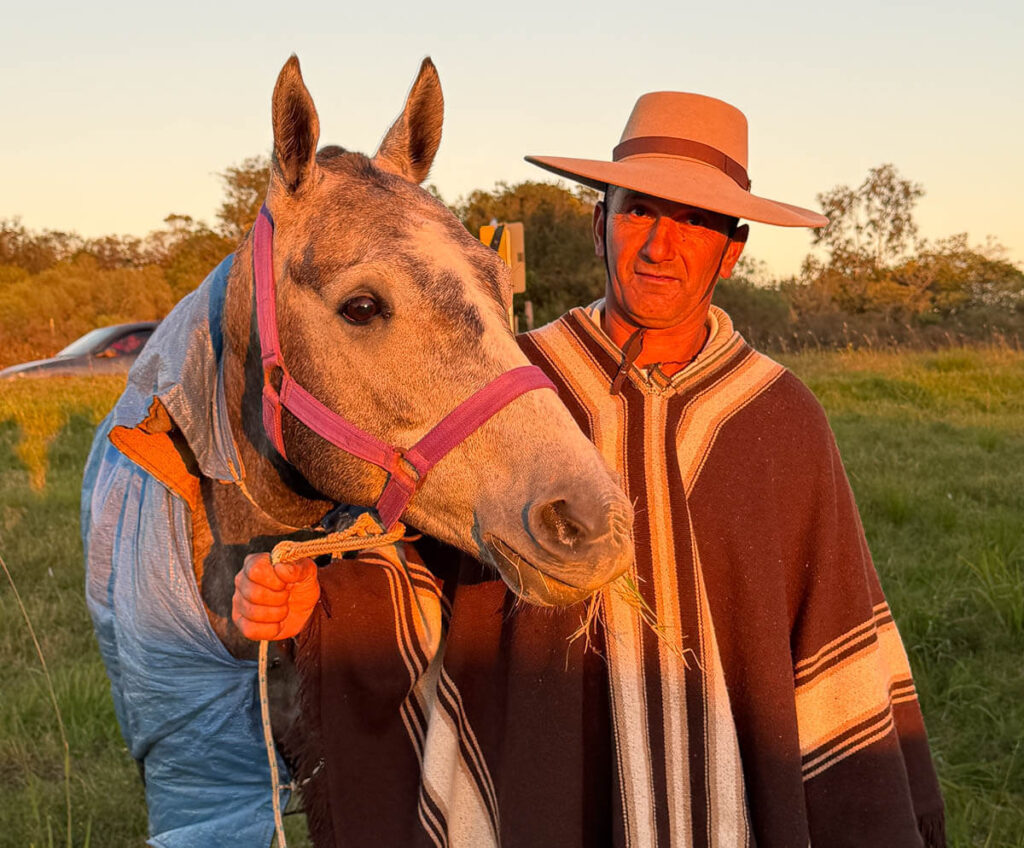
Uruguay might easily be one of the least visited countries in the Americas.
Squeezed between Brazil and Argentina, it is a small, mostly flat country that lacks the dramatic landscapes and iconic attractions found elsewhere on the continent.
To be honest, I didn’t have big expectations on Uruguay.
However, I firmly believe that every country in the world has something to offer, and Uruguay is a good example of that.
This is a country where life is taken slowly, where people spend hours chatting over a cup of mate, where rural traditions are still very much alive, and where the best you can do is simply wandering around, talking to locals and just enjoying your day.
That’s essentially what I did in Uruguay.
This travel guide is based on that experience and includes practical travel tips, recommendations, and a suggested one-week itinerary for exploring Uruguay.
In this travel guide for Uruguay, you will find:
Table of Contents
 Introduction: Is Uruguay worth it?
I actually traveled all the way to Uruguay, booking a round-trip ticket from Madrid just to visit Uruguay. Not many people do that.
Was it worth it?
Is Uruguay worth visiting, and is it worth flying all the way there just for Uruguay?
Well, first of all, I’m one of those travelers who believes that each and every country in the world deserves a visit. For me, Uruguay isn’t about debating whether it deserves to be visited or not. I liked it, I had fun, and I would definitely go back.
However, is it worth flying there just for Uruguay?
It depends on your preferences. I had a week to spare, I was traveling with a friend, and Uruguay was one of the few small countries I hadn’t visited yet. It’s also small enough that you can see a good part of it in one week. That’s why I went there.
Having said that, I should also mention that, besides Uruguay, we ended up spending a few days in Buenos Aires as well, which definitely helped make the trip feel more worthwhile.
 How to get a visa for Uruguay
A visa is not required to travel to Uruguay.
Upon arrival, all you’ll get ia a friendly entry stamp in your passport (although sometimes not even that), which allows you to stay in the country for up to 90 days as a tourist.
 Travel insurance for Uruguay
IATI Insurance is the most versatile insurance for any type of trip and destination, including Uruguay:
- Different plans for each kind of travelers
- Budget plans
- Covers senior citizens too
- Readers of this blog can get a 5% exclusive discount
 Best time to travel to Uruguay
Uruguay can be visited all year round, but it really depends on what you want to do.
Do you want to spend time at the beach in the coastal towns?
Personally, I don’t find that very interesting, but if that’s your thing, then be my guest. In that case, the best time to visit is in summer, from November to February (Southern Hemisphere).
If you want to follow the itinerary in this blog, however, you can visit at any time of the year. I think the shoulder seasons, spring and autumn, roughly from March to May and September to October, are probably the best times, when the weather is pleasant.
I visited Uruguay in May, and I thought it was a great time to be there. I barely saw any tourists.
 How to get to Uruguay
How to travel to Uruguay by plane
The main international airport is Carrasco International Airport (MVD), located just outside Montevideo. There are daily flights to and from Madrid with Iberia, and also Buenos Aires, São Paulo, Santiago and Panama City, among many others.
How to travel to Uruguay by ferry from Buenos Aires
Most people actually enter Uruguay this way. In fact, many travelers visit Uruguay as a short side trip from Buenos Aires, spending a few days in the country before returning to Argentina.
There are two main ferry destinations in Uruguay:
- Colonia del Sacramento – approximately 1 hour from Buenos Aires
- Montevideo – approximately 3 hours from Buenos Aires
Ferries operate daily, several times a day.
The two main companies operating these routes are Colonia Express and Buquebus, and tickets can easily booked online through their respective websites.
 How to move around Uruguay
How to travel around Uruguay by bus
I can’t add much from personal experience here, since I rented a car and drove all over the country.
However, traveling around Uruguay by bus is very straightforward. Most relatively large towns and cities are well connected, especially from Montevideo.
The main bus station in Montevideo is Tres Cruces, from where you can travel pretty much anywhere in the country, including Colonia del Sacramento, Punta del Este, Cabo Polonio, etc.
Driving around Uruguay
This is the best way to see the country, especially if you want to explore the countryside and gaucho territory.
I booked my car through Rentalcars.com, where you pay in advance, but if possible, try to book locally instead. This is because, when you collect the car and pay with a foreign card, you might get the VAT discount applied automatically. See the Money section for more details.
The roads in Uruguay are pretty good overall. There’s little traffic, and driving is pleasant.
However, there are a lot of speed cameras, and fines are really expensive, starting at around 200 USD even for slightly exceeding the speed limit, so be careful. Speed cameras are usually signposted, but there are mobile radars too.
 Money and budget in Uruguay
In Uruguay, the local currency is the Uruguayan peso (UYU) and, approximately:
1 USD = 40 UYU
Uruguay is an expensive country and, by South American standards, probably the most expensive country on the continent, especially when it comes to food, alcohol, and accommodation during the summer season.
How much does it cost to travel in Uruguay?
These are the typical costs of some basic things in Uruguay:
- Coffee: 80–160 UYU
- Empanada: 60–120 UYU
- Chivito sandwich: 350–600 UYU
- Meal at a local restaurant: 400–800 UYU
- Steak dinner at a parrilla: 800–1,600 UYU
- Local beer: 250 UYU
- Bottle of wine in a restaurant: 600–1,200 UYU
- Bed in a hostel dorm: 600–1,200 UYU
- Budget private room: 1,600–2,800 UYU
- Mid-range hotel: 3,200–6,000 UYU
- Gasoline: around 80 UYU per liter
SUPER PRO TIP: Pay with your foreign card whenever possible
In Uruguay, when you pay with a foreign debit or credit card at restaurants, car rental companies, and many other tourist-related businesses, you’ll automatically receive a VAT discount. You don’t need to tell the waiter or anyone else that you’re using a foreign card. Usually, you’ll receive the bill with the full amount, but once you pay by card, the discount will be applied automatically, making food and many other tourist services significantly cheaper. In restaurants, the discount is usually around 20%. The Uruguayan government introduced this measure to encourage tourism, particularly from neighboring Argentina and Brazil. Therefore, try to pay by card as much as possible during your trip.
ATMs and credit card in Uruguay
You can pay by card almost everywhere in Montevideo, the coastal towns, and Colonia del Sacramento.
In the countryside, however, cash is still often needed.
There are plenty of ATMs in Montevideo where you can withdraw cash, as well as numerous exchange offices.
Is Uruguay safe?
Uruguay ranks among the safest countries in Latin America.
While violent crime does exist in Montevideo, it’s almost nothing compared to what you find in many other Latin American capitals.
I stayed in the city center, in an area with quite a few rough-looking people. I asked several locals how safe that area was at night, and they all said the same thing: while getting mugged can happen, it’s very rare.
Outside Montevideo, Uruguay feels extremely safe, especially in small towns, rural areas, and along the coast.
 People and culture in Uruguay
Uruguayans are probably the most relaxed people in South America.
Uruguay feels much quieter and more low-key than Argentina, and Uruguayans are probably the most relaxed people in South America.
They are not loud, they never seem to rush, and most of the time, they just go with the flow, always with their mate in hand.
In Uruguay, you’ll see many people carrying a thermos everywhere they go. That’s for mate, the traditional herbal drink that Uruguayans are obsessed with. While mate is also widely drunk in Argentina, it’s Uruguayans who seem to drink it the most, anytime and anywhere.
Other than that, Uruguayans are culturally very close to Argentinians. They speak with a similar accent, are obsessed with football, and eat a lot of beef.
Language in Uruguay
Uruguayans speak Spanish, with an accent similar to the one spoken in Argentina, although slightly different.
Personally, I can’t really comment on the level of English in Uruguay, since I only communicated in Spanish and barely saw any foreign tourists during my trip.
That said, if you speak Spanish, traveling around Uruguay is very easy.
 Food in Uruguay
I rarely eat meat, like steak and this sort of foods, but I don’t think I’ve ever eaten as much meat as I did during my trip to Uruguay.
Even in the coastal towns, it was difficult to find fish on restaurant menus.
If you know anything about food in Argentina, Uruguayan food is very similar.
They do have some unique local things, like chivito, a massive sandwich usually made with beef, ham, cheese, egg, lettuce, tomato, and mayonnaise. Other than that, however, asado, meat, and wine are the basis of Uruguayan food culture.
Similarly to Argentina, and due to Italian migration over the last century, most restaurant menus also feature pasta, pizza, and that sort of staple.
In Montevideo, there are some amazing restaurants where you can enjoy excellent meat, but at the end of the day, the best meat is usually eaten at home, during a proper asado with locals. We also had some amazing food at Mercado del Puerto.
You’ll also find empanadas, milanesas, dulce de leche, and alfajores pretty much everywhere, just like in Argentina.
By the way, the local grape used for wine is Tannat, and it’s really good.
 Internet, and connectivity in Uruguay
How to get a local SIM card
I used an Airalo eSIM. It’s not the cheapest option, but then again, prices in Uruguay aren’t exactly cheap either.
Ever since eSIMs became widely available, I barely bother getting a local SIM card anymore.
If you prefer a physical SIM card, you can easily get one from the main local providers, such as Antel, Movistar, and Claro.
Internet in Uruguay
Internet in Uruguay is good. I had reliable 4G coverage almost everywhere, including in many rural areas, and Wi-Fi was usually OK.
Connectivity is one thing you definitely won’t have to worry about when traveling in Uruguay.
 Things to do in Uruguay in a 1-week itinerary
This is the itinerary I personally followed, and I’d probably do the same one again.
I found the coast to be the least interesting part of Uruguay, especially Punta del Este, which was the one place every single person recommended to me.
If you’re into beaches and bars, then OK, you’ll probably enjoy it. But other than that, I didn’t find it offered much value. Seeing the sea lions was cool, yes, but I had just returned from the Falkland Islands so…
Anyways, my itinerary was heavily focused on the rural part of Uruguay, which I personally found much more interesting.
Map of the things to do in Uruguay
Day 1. Arriving in Montevideo
My flight arrived late in the evening, so on Day 1, all I did was take a short stroll around my neighborhood and have some local food.
I booked an Airbnb on Av. 18 de Julio, right in the center of Montevideo.
That evening, I had dinner at a very Uruguayan bar called El Gaucho, where I had my first milanesa.
Day 2. Full day in Montevideo
One piece of advice: try not to spend this day on a Sunday because, on Sundays, Montevideo is literally dead. Almost everything is closed and there are very few people on the streets.
However, if you can’t avoid visiting on a Sunday, keep in mind that this is when the Feria de Tristán Narvaja takes place, a massive street market that stretches for several blocks and sells pretty much everything you can think of. It’s very Uruguayana and it’s packed with people.
On that day, like everyone else, head to the Old City (Ciudad Vieja) and definitely have lunch at the Mercado del Puerto.
Funny enough, despite its name (Port Market), there’s barely any fish to be found there. We ate at Cabaña Verónica, where we had really good asado, chorizo, and wine.
If you’re looking for something simpler and more local, right next to the market there’s a local eatery called Restaurant El Navegante. I liked it a lot, especially the people I met there eating.
After lunch, it’s all about walking around the city. If you have time, I recommend heading to Punta Carretas and Pocitos, which feel more modern than the historic center.
There are plenty of cool bars and cafés, it’s a nice area to hang out, and the seafront promenade is perfect for a pleasant walk.
Day 3. Colonia del Sacramento
I drove from Montevideo to Colonia del Sacramento, a journey of around 2.5 to 3 hours.
Colonia is Uruguay’s most touristy destination, excluding the coastal towns. It’s extremely laid-back and has a nice historic center with cobbled streets and colonial houses.
There isn’t a lot to do here, but it’s worth spending one afternoon and evening before hitting the road again the next day.
By the way, here’s a super local tip: on the way from Montevideo to Colonia del Sacramento, there’s a village named Colonia Valdense, where you’ll find a small restaurant serving what locals told us was one of the best chivitos in the country.
I don’t know whether it was actually the best or not, but it was on the way anyway.
Day 4. Rivera
This is a long drive. It takes the entire day to get to Rivera, since you’ll be crossing almost the entire country from south to north, covering more than 600 km.
It’s a long drive, nevertheless, and one that I really enjoyed, since you’ll be traversing endless fields and flat land, entering gaucho territory, where you’ll start seeing locals wearing cowboy hats, riding horses, and hundreds, if not thousands, of cows grazing freely.
It’s a cool drive. I liked it.
On the way, I stopped at an extremely local bar frequented by farmers from the area. They were all drinking wine, but the place only served wine in Tetra Pak cartons. I had some good chats with the people there, although you’ll definitely need Spanish. To be honest, even I struggled to understand some of them. The bar was here.
For me, this area and everything beyond it was the most authentic part of Uruguay.
About Rivera, it’s a town where half of it is in Uruguay and the other half is in Brazil. There’s no border in between; in fact, the border literally goes through the main square. Seriously, you cross the street and gas is half the price, restaurants serve Brazilian food, and things are quoted in reais.
There’s no need to go through immigration if you just walk across the square (I even spent the night on the Brazilian side), but if you leave the town and continue into Brazil, then you will have to.
It’s also interesting to mention that, just across the street on the Brazilian side, there are loads of things going on, the streets are packed, and there’s a lot of life, whereas on the Uruguayan side, not so much, which, as you already know, is very much in line with the more relaxed Uruguayan lifestyle.
Where to stay in Rivera
Hotel Ermitage. Good mid-range option.
Day 5. Tucuarembó and road 26 to Melo
Along with the previous day, this was the most interesting part of the trip.
Tacuarembó is considered the capital of Uruguay’s gaucho culture, and the drive along Route 26 towards Melo was probably my favorite road in the country.
If you’re not familiar with gauchos, they are essentially the South American version of cowboys, traditionally associated with Uruguay, Argentina, and southern Brazil. They played a fundamental role in shaping the culture and identity of these countries, and while modern life has changed many things, gaucho culture is still very much alive in rural Uruguay.
This is where you’ll see them the most: men wearing berets or cowboy hats, riding horses, working on cattle ranches, stopping for mate, and living at a pace that feels completely detached from the modern world.
Tacuarembó is their capital. There’s not much going on in the city itself, but every year it hosts what is probably the country’s most important gaucho event: the Fiesta de la Patria Gaucha. It usually takes place over a week at the end of February, although dates may vary from year to year. It must be an amazing time to visit.
Route 26, linking Tacuarembó and Melo, crosses one of the most unspoiled regions of Uruguay. Hardly anybody drives through here, but you’ll pass countless farms and tiny villages where you’ll have plenty of opportunities to interact with local gauchos. You’ll see them in bars, gas stations, and pretty much everywhere else. It’s always interesting to hear their perspective on life.
Also, perhaps I was just lucky, but I happened to come across a local horse race, which was pretty cool.
The drive to Punta del Este the following day is a long one, so I’d recommend staying wherever is most convenient for you. There are small hotels and guesthouses in pretty much every town along the route.
Day 6. Punta del Este
As I mentioned earlier, I found Punta del Este to be the least interesting part of Uruguay. Big buildings, impersonal restaurants, not a lot of culture. It just didn’t add any value to what I seek when I travel.
However, I acknowledge that it’s a good place to finish the trip before heading to the airport. It’s comfortable, there are loads of food options, and everything is very easy.
I didn’t go for a swim because it was too cold, but I did see a bunch of sea lions from very close. You could basically touch them if you wanted to.
Punta del Este is just a place to chill and relax. Don’t expect to learn much there.
Where to stay in Punta del Este
San Martin. Basic but coy private rooms.
Day 7. Departure
On the last day, I had one last meal at another local restaurant near the airport before dropping off the car.
This is the place where I had lunch, highly recommended! Meat, wine, fair prices.
 Is Uruguay worth it?
I actually traveled all the way to Uruguay, booking a round-trip ticket from Madrid just to visit Uruguay. Not many people do that.
Was it worth it?
Is Uruguay worth visiting, and is it worth flying all the way there just for Uruguay?
Well, first of all, I’m one of those travelers who believes that each and every country in the world deserves a visit. For me, Uruguay isn’t about debating whether it deserves to be visited or not. I liked it, I had fun, and I would definitely go back.
However, is it worth flying there just for Uruguay?
It depends on your preferences. I had a week to spare, I was traveling with a friend, and Uruguay was one of the few small countries I hadn’t visited yet. It’s also small enough that you can see a good part of it in one week. That’s why I went there.
Having said that, I should also mention that, besides Uruguay, we ended up spending a few days in Buenos Aires as well, which definitely helped make the trip feel more worthwhile.
 More travel information
 In my Travel Resources Page you can find the list of all the sites and services I use to book hotels, tours, travel insurance and more.
Travel guides to other countries in the Americas
- Haiti Travel Guide
- Venezuela Travel Guide
- Trinidad and Tobago Travel Guide
- Falkland Islands Travel Guide
Comments
Post a Comment