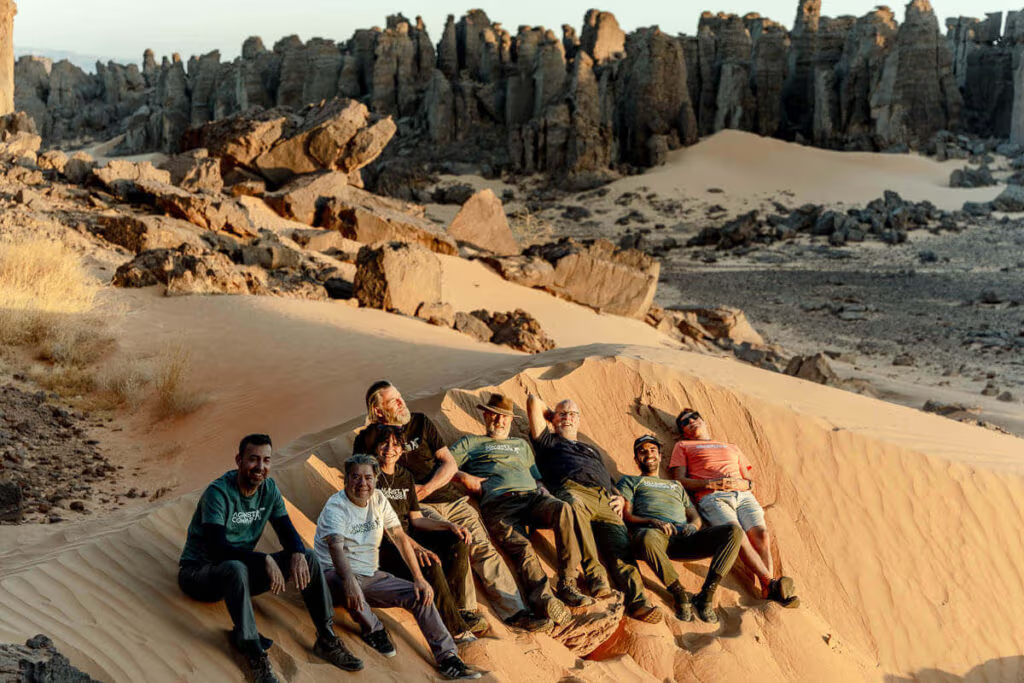
The largest country in Africa is also one of the most diverse, from the sophisticated French Quarter of Algiers to the heartland of the Tuareg in Tamanrasset and Djanet, passing through the homeland of the Mozabites in the area around Ghardaïa.
This is almost the exact itinerary for Algeria I followed during my first visit to the country.
By the way, for general tips on Algeria, including visas, getting there, money, etc., check our travel guide to Algeria.

In this travel itinerary for Algeria, you will find:
Table of Contents
- Tours
- Itinerary
- Day 1: Arrival in Algers
- Day 2: Algers
- Day 3: Way to Ghardaïa
- Day 4: Ghardaïa
- Day 5: Fly to Constantine
- Day 6: Day trip to Timgad
- Day 7: Tamanrasset & Assekrem
- Day 8: Assekream and around
- Day 9 to 12: Djanet and Tassili N’Ajjer National Park
- Day 13: Fly back to Algers
- More Information
Tours for Algeria
It’s possible to travel to Algeria on your own. It should not be too difficult for experienced travelers but if you wish to travel with a group of like-minded travelers and do this itinerary with Against the Compass, know that we have several scheduled expeditions to Algeria.
Next departures to Algeria:
- December 5th to 12th, 2026 – APPLY NOW

Travel itinerary for Algeria
This 2-week itinerary focuses on both the north, including Algiers, Ghardaïa, and Constantine, and the south, including Djanet, and the lesser-visited Tamanrasset.
If you only have one week, you can choose either of them.
Map of our Algeria travel itinerary
Here are the places we visit in our Algeria itinerary.
Day 1: Arrival in Algers, capital of Algeria
You landed, perhaps on a morning flight, but take into account that immigration can often take a while, sometimes more than a few hours.
It just depends on your profile, passport stamps, and the type of visa you are traveling in Algeria with.
For all the information on visas, please check the visa section of our Algeria travel guide.
In my case, I traveled to Algeria with a visa on arrival, but my Syria, Afghanistan and Yemen visas triggered too many questions, making me wait for about two hours.
Eventually, however, you will get your stamp, but do remember that when you plan your first day in Algiers.
After checking into my hotel, all I did on the first day was walk around the sophisticated French Quarter, checking some pretty cool colonial architecture while exchanging money at Port Saïd Square, located right in front of the Tantonville’s Café.
In the evening, I walked along the seaside, stopping for a beer at Restaurant Le Dauphin, expensive, but it has an outdoor terrace with sea views and beer, it can’t get any better.


Where to stay in Algers
Budget Hotel – Afric Hotel. Located at the heart of the Qasbah.
Mid Range Hotel – City Hotel. A standard hotel in the new part of town.
High-end – Sofitel. One of the best hotels in town.
Day 2: Algers, the Qasbah
I spent a full second day in Algiers, this time with a higher focus on the Qasbah, which is the old town of Algiers.
The Casbah of Algiers is worldwide famous but, to be very honest, most of it is in a deplorable state, not very well taken care of, probably due to the lack of tourists, hence lack of investment.
However, it is still nice to walk around the many intricate lanes while checking all its viewpoints.
If you like seafood, on the upper part of the Qasbah there are a few very local eateries offering super affordable meals, like calamari stew, among other staples. The place is called Le Petit Pêcheur.
Post Office of Algiers
La Grande Poste d’Algiers. Located in the French Quarter, the main post office in Algiers features an impressive colonial building. I don’t know whether you send postcards or not but, since 2024, I do send one postcard to my son from every country I visit. I did send one postcard from this post office and received it in less than 2 weeks. You can find postcards in a nearby bookstore, located right here.
Other things to see in Algers
- Admiralty Lighthouse. A common spot among families and local people, especially at sunset. I liked coming here for the local vibe.
- Church of Notre Dame d’Afrique. The largest church in Algeria features amazing views of the city.
- Hotel El Djazair. A vintage hotel that has hosted many celebrities, including Karim Benzema. It’s expensive and probably hasn’t been renovated in decades, but its past glory is still tangible. Worth checking it out and having some wine.

Day 3: Way to Ghardaïa
Ghardaïa is located 600km from Algiers.
Most travelers take the Air Algérie flight but in our Algeria tours, we often make this stretch by land, passing by the Monastery of Médéa and spending one night in Laghouat.
You can also make this journey by bus, but it’ll definitely take the entire day.
Either way, on my first visit, the flight to Ghardaïa left in the evening from Algiers, so I still arrived there at the end of the day.
Where to stay in Ghardaïa
Maison Akham. A simple, but traditional hotel.
Belvedere. A proper hotel with reception.
Day 4: Ghardaïa
Ghardaïa is the main city of the M’zab Valley, a UNESCO-listed region in Algeria founded in the 11th century by the Mozabites, an Amazigh (Berber) community who follow a distinct version of Islam with very strict social codes, but also a strong sense of community and identity, something they have preserved for nearly a thousand years.
The architecture here is very unique and photogenic, a real highlight for most travelers visiting.
Beyond its unique architecture, one of the most distinctive things is the traditional dress of Mozabite women, who wear a white veil covering the entire body and face, leaving only one eye visible.

Ghardaïa is actually an area composed of many different towns, each one with its own character, even rules.
Some of their old cities don’t allow any outsiders wandering by themselves, but you must always be accompanied by a guide, the office of which is at the main entrance of the respective Qasbah.
It’s obviously possible, and easy, to sneak in through one of the many streets and lanes, but you are likely to be shouted at in less than a minute by the first local you bump into.

Places I recommend visiting in Ghardaïa:
- Ghardaïa Market and around. It’s a crowded area and, since it’s a market and an open space, you are allowed to take photos of people.
- El Atteuf. The most beautiful Qasbah.
- This view point
- Beni Isguen. The most conservative town in Ghardaïa, not allowed to wander around by yourself.
Note that Ghardaïa is a super conservative town, with very strict rules on photography, especially of women, it’s strictly not allowed.
I did take a few, as you can see, but you are technically not allowed to do that.


Day 5: Fly to Constantine
The distance between both cities is 740 km.
In our overland itineraries from our Algeria tours, we do this stretch by minibus in 2 days.
The first time I visited, however, I took a flight, which departed very early in the morning, around 1 am. This allowed me to take a small rest and then have the entire day to visit Constantine.
Constantine is one of Africa’s most unique cities, famous for its spectacular suspension bridges linking different parts of the city.
It’s actually pretty beautiful, quite photogenic, something you have never seen on this continent, plus it also has a different energy, with people being very open and welcoming.
You can walk across all the iconic bridges, check out the different viewpoints and just get lost in the local market and bazaar, which I recommend visiting first thing in the morning, when it’s packed.
In the evening, if you’d like a drink, Novotel is located right next to the Qasbah and has a bar serving Algerian wine, which is probably the best wine in Africa after South African.

Where to stay in Constantine
Backpacker Budget – Hostel le Rhumel. A hostel for backpackers.
Budget Hotel – El Bey. A little bit outside of town but standard hotel with good rates.
Mid range Hotel – Novotel. Inexpensive for what you get, plus it has a bar and best location.
Day 6: Day trip to Timgad
Timgad is a 2–3-hour drive from Constantine depending on traffic, so it’s quite a drive, and even longer if you are planning to do it by public transportation.
For me, this day trip made sense because at 9 pm I had my direct flight from Constantine to Tamanrasset, so if you follow this very same itinerary and take a taxi, it’s completely doable.
Personally, I am not into Roman ruins, but Timgad is supposed to be one of the best-preserved Roman cities in North Africa, founded around 100 AD by Emperor Trajan as a military colony.
You are likely to get these Roman ruins just by yourself.
By the way, Timgad is located in a village also named Timgad, so you’ll find loads of local restaurants in here.

Day 7: Tamanrasset & Assekrem
As mentioned, my flight to Tamanrasset left at 9 pm from Constantine, so we landed in the southern city almost past midnight.
Tamanrasset is a sensitive area, with local police and military being extremely paranoid about AQIM activity on the other side of the border in nearby Mali.
Some foreigners have been kidnapped in that area, including a Spanish tourist who was released in 2025.
As a traveler visiting Tamanrasset, however, you should not be worried about it, since all the terrorist activity is concentrated in the south of Tamanrasset, towards the border, while tourist sites such as Assekrem are in a different direction.
Anyways, that’s the reason why in Tamanrasset there are barely any tourists, and the few who travel there are always followed by the local police or gendarmerie from the moment you leave the airport.
It actually took me a while to get the clearance for leaving the airport, which the local tour company I worked with took care of. In fact, I don’t think it’s possible to travel to Tamanrasset on your own without any permit. Well, you can travel there, just that I don’t know whether they’ll allow you to leave the airport.
By the time I reached the hotel, it was nearly 2 am.
What to actually do in Tamanrasset

If you compare Djanet with Tamanrasset, everyone will say that Djanet is much more spectacular, but I disagree.
While it’s true that the desert of Djanet is much more beautiful, poetic and also cultural, Tamanrasset has Assekrem, which is the best single site in all Southern Algeria, a dramatic mountain plateau in the Ahaggar Mountains located at 2,780 meters above sea level, and where you get one of the most spectacular sunsets (and sunrises) I can ever think of.
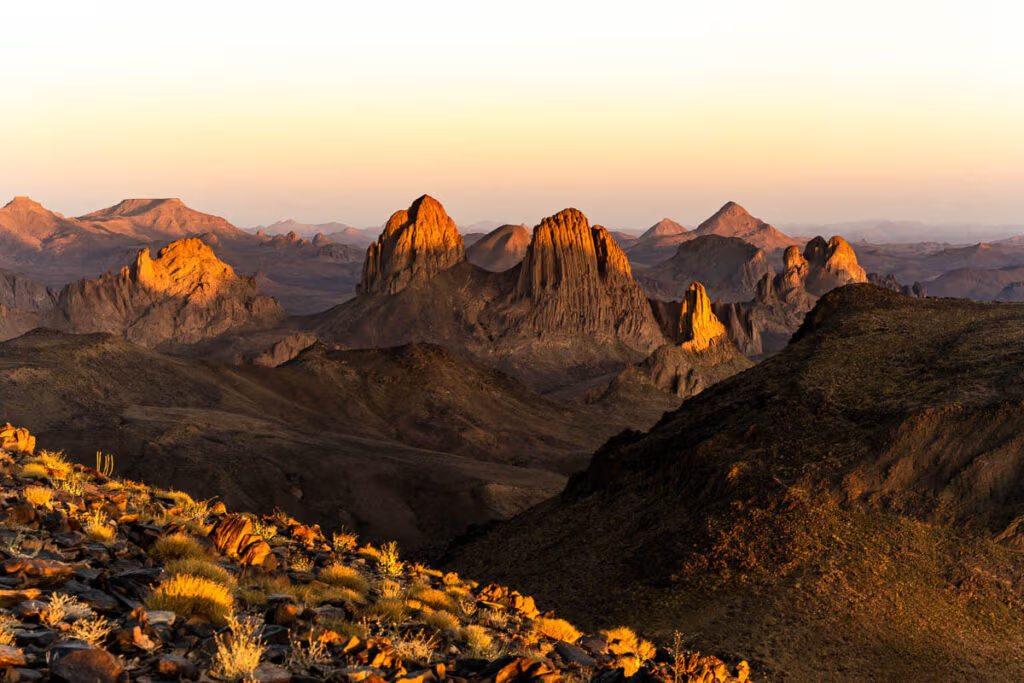
While it’s true that you do find high-altitude frozen deserts in the Himalayas, I just don’t recall any desert, as per the book, at such high altitudes.
On the top of the mountain where you see sunset, there’s the hermitage of Charles de Foucauld, inhabited by a Spanish monk who has been living there for almost 20 years. He doesn’t speak English, but speaks French and obviously Spanish. If you are lucky to meet him, he’s super talkative and loves to tell stories, it was my highlight in Assekrem.
In Assekrem, you can do camping, and your tour company should be in charge of doing that.


Day 8: Assekream and around
On this day, what we did was drive slowly to Tamanrasset, stopping in a Tuareg camp on the way.

Something I actually loved from this area in comparison to Djanet is that the Tuareg camps are authentic and untouched, so raw that it’s not allowed to take photos when there are women, but the problem is that there are always women there.
Djanet Tuareg camps, on the other hand, tend to be tourist-oriented, but accessing them is much easier.
Anyways, it was great to see that side of Touareg life. We arrived in Tamanrasset in the evening, walked around town, slept for a few hours, and then took a very early morning flight, leaving at 3 am towards Djanet.
Flight schedules in this part of the world are at very inconvenient times.
By the way, if you wish a drink, there’s only one bar in Tamanrasset, in Tahat Hotel.
Day 9 to 12: Djanet and Tassili N’Ajjer National Park

I don’t think you need to book a tour to be allowed to leave the airport but, in any case, you obviously need a local company to venture into the desert. It doesn’t make much sense to come all the way to Djanet just to stay in the town, which isn’t very interesting anyways.
Anyways, the flight from Tamanrasset to Djanet is a very short one, not more than 30 minutes, but a 2-day drive.
I arrived early in the morning, so after getting a few more hours of sleep, with a team of Touaregs, I ventured straight into the desert into the Tassili N’Ajjer National Park, where I spent with the group the following 3 nights, a multi-day desert expedition, sleeping in one of the most starring skies in Africa.
Tassili N’Ajjer National Park is a surreal stone forest of eroded sandstone pillars, natural arches, narrow canyons and prehistoric rock art dating back more than 10,000 years.

What I liked about Tassili is its variety, the landscape changing completely every few kilometers, hence each day offering a different experience, all combined with the ancient rock art and occasional herds of camels with their Tuareg shepherds.
On the last day, we came back after lunch, took a much-needed shower, a powerful nap and then we walked around Djanet, checking out the local market where you can buy souvenirs.
Djanet town is all right. I just prefer Tamanrasset, it looks more rough.

Day 13: Fly back to Algers
The flight back to Algiers was also super early in the morning, like at 6 am.
Upon arrival in Algiers, you can either stay at the airport to fly back home or go to the city.
My flight wasn’t departing until 6 hours from the moment I arrived from Djanet. To kill all those hours, I discovered that the airport has a Hyatt hotel that offers a very good buffet-style breakfast at a very reasonable price, a type of luxury needed after the 7-day desert expedition.
Some friends had the whole day and decided to take a day trip to Tipaza by taxi, a ruined Roman city by the seaside. They said they loved it, especially the seafood restaurants next to it.
That’s all about our Algeria itinerary.
As mentioned, we offer similar itineraries in our Algeria Expeditions. Any questions, please let us know.
 More information for traveling in Algeria
 In my Travel Resources Page you can find the list of all the sites and services I use to book hotels, tours, travel insurance and more.
All guides and articles for traveling in Algeria destination
Travel guides to other countries in Africa
- Tunisia Travel Guide
- Ethiopia Travel Guide
- Eritrea Travel Guide
- Somaliland Travel Guide
- Travel Guide to Sudan
- Travel Guide to Egypt
- Libya Travel Guide
- Mali Travel Guide

Comments
Post a Comment